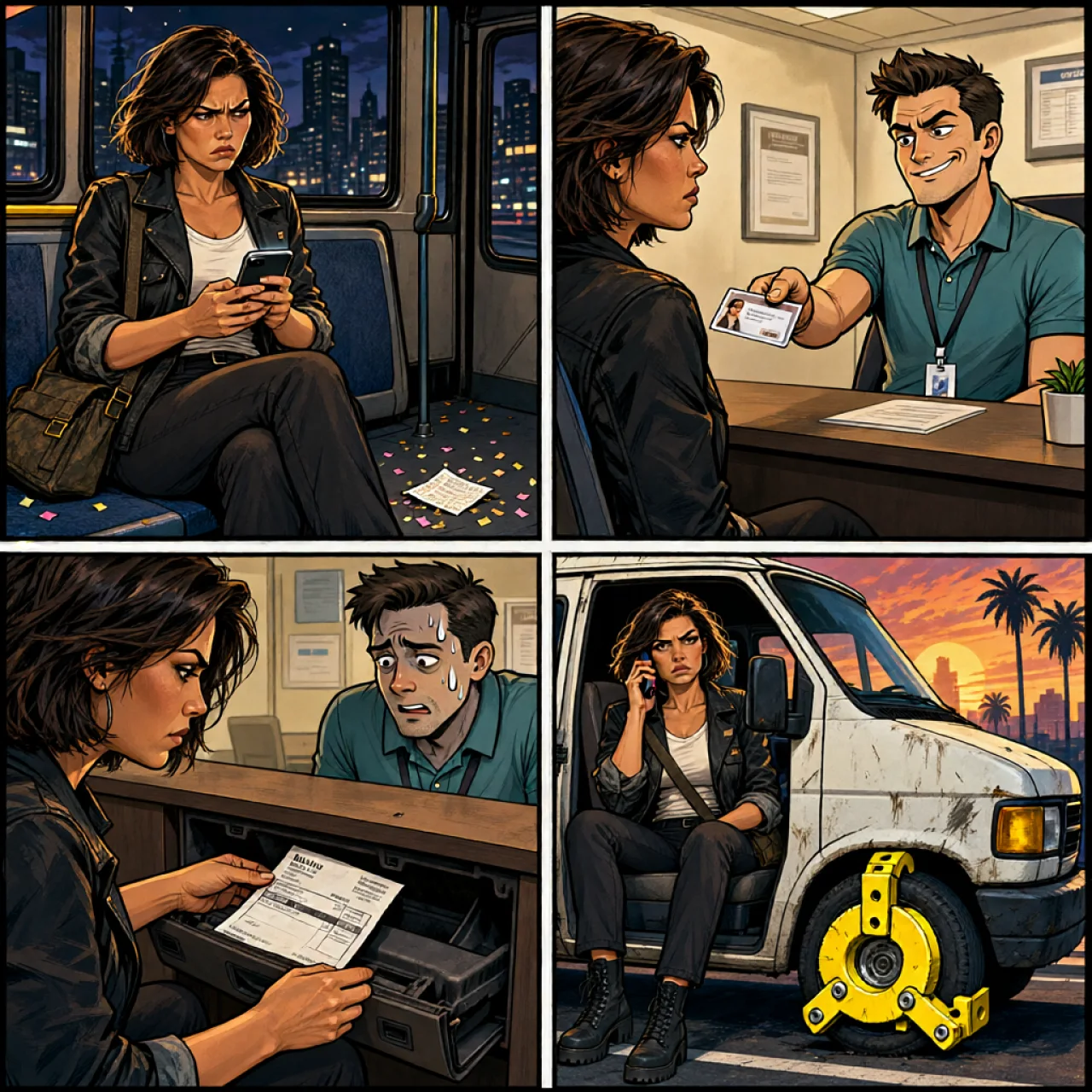
LOS SANTOS — The customer satisfaction survey arrived at 6:02 a.m., before the confetti of my last payment had finished settling into the floor of the 24-hour bus. Civic Recovery Partners wanted to know how likely I was to recommend their disposal services to a friend. The scale ran from one to ten. Every number was labelled "extremely likely."
I selected "request a callback." The form said callbacks were reserved for account holders and asked for an account number. I typed in the reference number from the deferred invoice in the glove compartment. The page thanked Mr. Len for eleven loyal months, which is how I learned the free trial had been booked in his name and booked an escalation appointment for 9 a.m. at a strip mall off the freeway, between a laundromat and a shop that sells extended warranties for other extended warranties.
I had no money, no van and no taxi company willing to hear my name, so I walked. The editor called on the way to say that walking was not an expense category, and that the first story against her advance was now overdue in a way she could feel physically.
The Civic Recovery office had beige blinds, a water cooler with no water in it and a framed certificate thanking the police department for "a decade of partnership in making things go away." Behind the desk sat Brayden, the man who had sold me priority access at the auction. He wore a different lanyard. He said customer service was a portable skill.
I told him I was there on Mr. Len's behalf to cancel his subscription. Brayden's face did something complicated, then reset to pleasant. He slid a laminated card across the desk titled Before You Go. Cancelling customers, he explained, were entitled to a retention offer, and the system had flagged one item in Mr. Len's account history: a white news van with my name on both doors, recently bought at auction for $550 by a company employee acting as a "loyalty buyer."
"That was you," I said.
"That was a loyalty purchase," he said.
The retention offer was simple. If Mr. Len's subscription stayed active, the van would be released to the account holder's representative as a thank-you gift, subject to a gift-processing fee. If the subscription ended, the van would be "repurposed," which the price sheet defined as crushed, cubed and sold back to the auction as a garden feature. I asked how much the fee was. Brayden said $75 a month, the same as the subscription, because the gift was the subscription.
I put the glove compartment on the desk and opened it. The deferred invoice sat on top: $300 for priority disposal, billed to the department, approved by Captain Denny Rusk and never paid. Brayden stopped being pleasant. A company that sells the police the service of losing things is sensitive about paperwork showing a police captain owes it money. The only thing worse for that business than a customer who won't pay is a customer nobody is allowed to chase.
We negotiated. He wanted the invoice. I wanted the van and its keys, in that order. He offered a receipt instead of keys. I offered to read the invoice aloud into my editor's voicemail, which, I mentioned, is recorded for quality and training purposes.
At 9:40 a.m. I had the keys. The van stood in the parking lot with a bright yellow wheel clamp on the front tyre, stamped Property of a Valued Customer. Brayden said the clamp would come off automatically once the first monthly payment cleared. The subscription, he added, was now in my name, because I had signed the cancellation form as Mr. Len's authorised representative and the system had treated that as a change of ownership. It renews on the twenty-second of every month.
He kept the invoice. I kept a photograph of it, which he noticed and then decided not to have noticed.
I called the editor from the driver's seat of a vehicle that could not move. I told her I had a story: a private company that sells the police a subscription to make seized property vanish, a captain who doesn't pay his share, and a reporter who now subscribes to her own van. She said it was the first good thing I had filed this month and that she would count it as two stories. Then she deducted the first monthly fee from my advance, on the grounds that I was clearly using the van for work.
Uncle Len texted to congratulate me on my new account and attached an invoice for introducing me to a valued partner: $300, plus bus fare.
So, for the record. I have my van back, clamped. The advance stands at $350. I owe the editor nine more stories. I still owe Civic Recovery Partners $13 for a taxi I never finished riding in, and $75 a month for the privilege of owning my own vehicle. Captain Rusk's unpaid invoice is back in the company's filing cabinet. A photograph of it is in my phone, and tomorrow I'm going to ask him why a police department needs a subscription to forget things.
Spotted an error? Help keep the record straight.