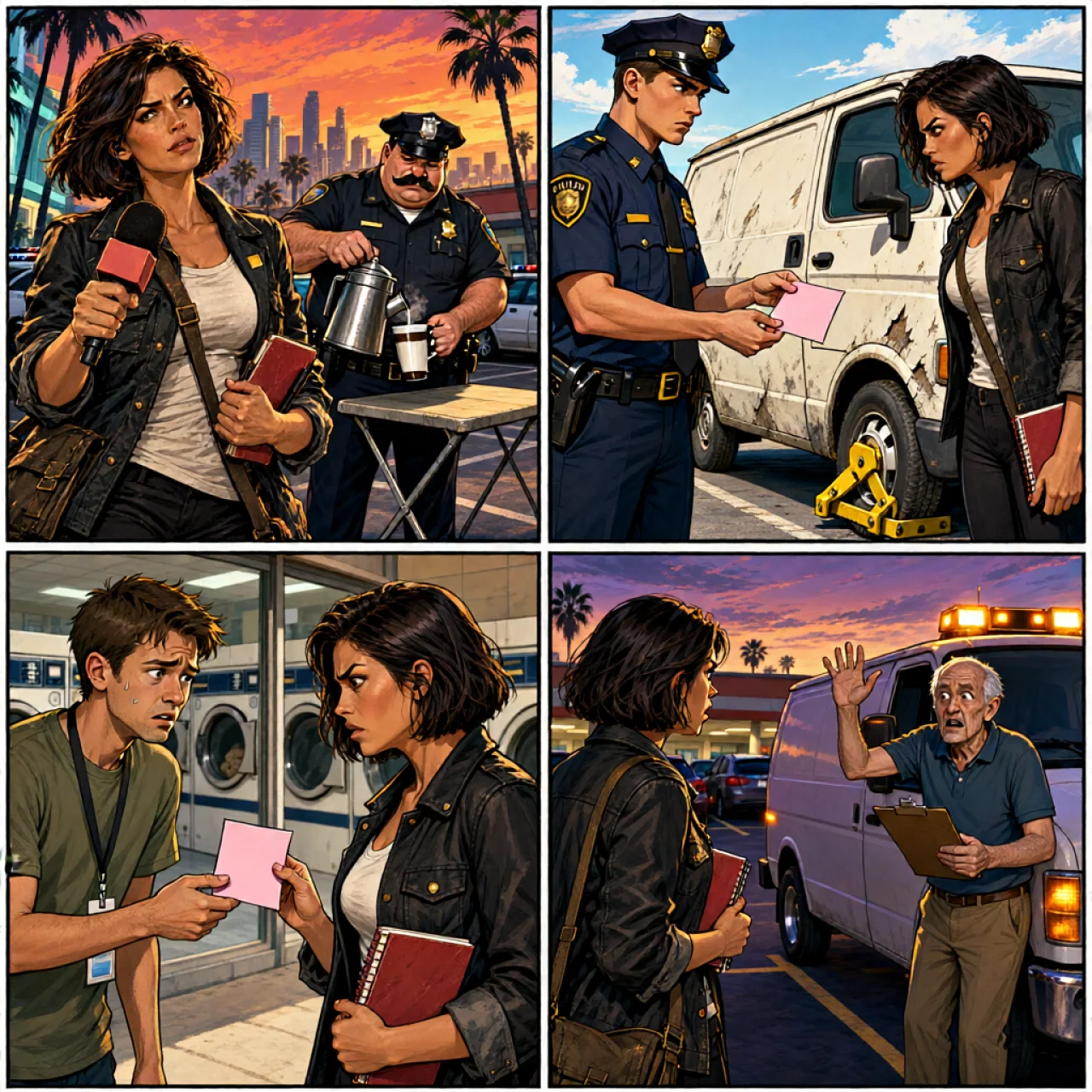
LOS SANTOS — The first payment did not clear overnight. The editor had sent it to Civic Recovery Partners from my advance, and the company's app now showed it as "processing with gratitude," which a help article defined as three to five business days. The clamp on my van stayed where it was. Someone had stuck a smiley-face sticker on it.
So I walked to the precinct. Every Thursday at 8 a.m., Captain Denny Rusk holds Coffee With the Captain, a community session in the front car park with a folding table, a banner and a coffee urn the department says is "funded by asset recovery." The banner said PROPERTY CRIME DOWN 40%. Nobody at the table could tell me where the property had gone.
Rusk was shorter than he looks at auctions and much friendlier. He poured me a cup, asked whether I took sugar and told me there was none, because sugar had been seized in a raid in March and was awaiting disposal.
I showed him the photo on my phone: an invoice for $300, "priority disposal," billed to the department, approved by D. Rusk, unpaid.
He looked at it for a long time, the way a man looks at a parking ticket on someone else's car. Then he explained, warmly, that the department does not pay for disposal. Disposal is community-funded. When the police seize a car, Civic Recovery offers the owner a subscription to stop it being crushed. The owner pays. The department receives what he called a partnership acknowledgement, and the invoice is simply how the company says thank you.
"So the invoice runs the other way," I said.
"It's a relationship," he said. "Relationships run both ways."
I asked how much a partnership acknowledgement was worth, and how many cars the department had referred this year. He said both were operational, and could I please put my notebook away near the pastries.
Then he made his offer. If the photograph disappeared, the department would waive my outstanding $13 taxi balance with Civic Recovery as a goodwill gesture, and I would get a seat at his monthly press briefing, where the coffee comes with sugar. I said I would rather keep the photograph. He said that was my right as a member of the community, and finished his coffee.
At 9:15 a.m., an officer I had never met walked up and handed me a citation. My van, he said, had been reported abandoned in a commercial car park overnight. The fine was $120. Abandoned vehicles that remain unclaimed after thirty-six hours are referred to the department's disposal partner. The officer told me I had until 5 p.m. tomorrow and wished me a nice day in a voice that meant it as an instruction.
I pointed out that the van was not abandoned. It was clamped, by the same disposal partner, until my subscription payment cleared. He wrote that down under Statement of Owner and spelled clamped with a K.
I called the editor from the bus shelter. She said the story was good and did not exist yet, because a captain explaining a business model at a coffee urn is an anecdote, and an anecdote needs a second source. She added that she would not advance $120 for a parking fine on a van she was already paying a subscription for. She called that double-dipping and said she had a rule against it, unless she was the one dipping.
There was only one person I could think of who had seen both sides of the invoice. Brayden answered on the first ring. He said he couldn't speak on the record, off the record, or near any record. I told him the department was refusing to pay his company's invoice, and that his company was going to tow my van to collect from me what it couldn't collect from the captain. His silence sounded like customer service failing to find an answer in the script.
We met at noon behind the laundromat. Brayden brought a printout folded into eighths: the company's referral ledger, a column of plate numbers with a fee of $40 next to each one, paid to an account labelled COMMUNITY PARTNER (RUSK). My plate appeared on it four times. Once after the auction, once after the tow, once when the van was repurposed into a gift and once dated tomorrow, at 5:01 p.m.
"It's pre-booked," Brayden said. "The system likes to plan ahead."
I asked why he was giving it to me. He said the captain hadn't paid for priority disposal, so technically the captain wasn't a customer. Brayden believed in serving customers.
I spent the afternoon at the impound lot fence, checking the ledger against plates. Eleven matched.
At 6 p.m., I walked back to the strip mall to sit in my van and write. A Civic Recovery tow truck was already reversing up to the front bumper, a day early, with its amber lights turning. The driver leaned out in a company polo shirt and a lanyard that read Independent Contractor. It was Uncle Len, and he was holding a clipboard with my name on it.
So, for the record. Cash: $0. The editor's advance stands at $350, and the first $75 subscription payment is still processing with gratitude. I owe the editor nine stories. I owe Civic Recovery Partners $13 for the taxi and $75 a month for the van. I owe the city $120, due by 5 p.m. tomorrow. I owe Uncle Len $300 plus bus fare. I own a clamped van with a tow hook on its bumper, a phone photo of an invoice and a ledger folded into eighths with my plate on it four times.
Spotted an error? Help keep the record straight.